A driveway gate is one of the few things on a property you’ll use every single day, so it pays to choose it carefully. The right gate fits the drive, opens the right way for the slope, suits the house and can take an opener later if you want one. Here’s how to choose a driveway gate, taking the decisions in the order we’d make them: site first, then type, size, material and style.
We design and build custom driveway gates at our shop in Cave Spring, just southwest of Rome, and every gate is fitted to its own opening. If your main question is budget, start with our guide to what drives driveway gate cost. This post is about choosing the gate itself.
Start with the site
Before you look at styles, look at your drive:
Width of the opening. Measure between the posts or columns you have, or where they’ll go.
Slope. Does the drive rise or fall behind the gate? A drive that climbs behind the gate can stop a swing gate partway open.
Setback. How far is the gate from the road? A car waiting for the gate should be able to sit fully off the road.
Room to open. Is there a clear arc for leaves to swing into, or a clear run along the fence line for a slider?
Columns and posts. Are existing columns plumb and strong enough to carry a gate?
Local rules. In the City of Rome, fence and wall heights in yards next to a street are limited. Our driveway gate cost guide summarizes Rome’s rules, and other towns set their own.
Swing vs. slide gates
Swing gates are the most common choice for homes. Sliding gates solve specific site problems.
Gate type
Works best when
Watch out for
Swing gate
The drive is fairly level behind the gate and there’s room for the leaves to open
Uphill slopes behind the gate, short setbacks, and wind on solid leaves
Sliding gate
The drive rises behind the gate, space is tight, or the opening is very wide
It needs clear space along the fence line at least as long as the opening, plus a track or cantilever frame
Is a sliding gate better on a hill?
Often, yes. A sliding gate moves parallel to the road, so the slope of the drive behind it matters much less. A swing gate can sometimes work on a slope with special hinges or by swinging toward the downhill side, but the site usually decides.
Single vs. double leaf
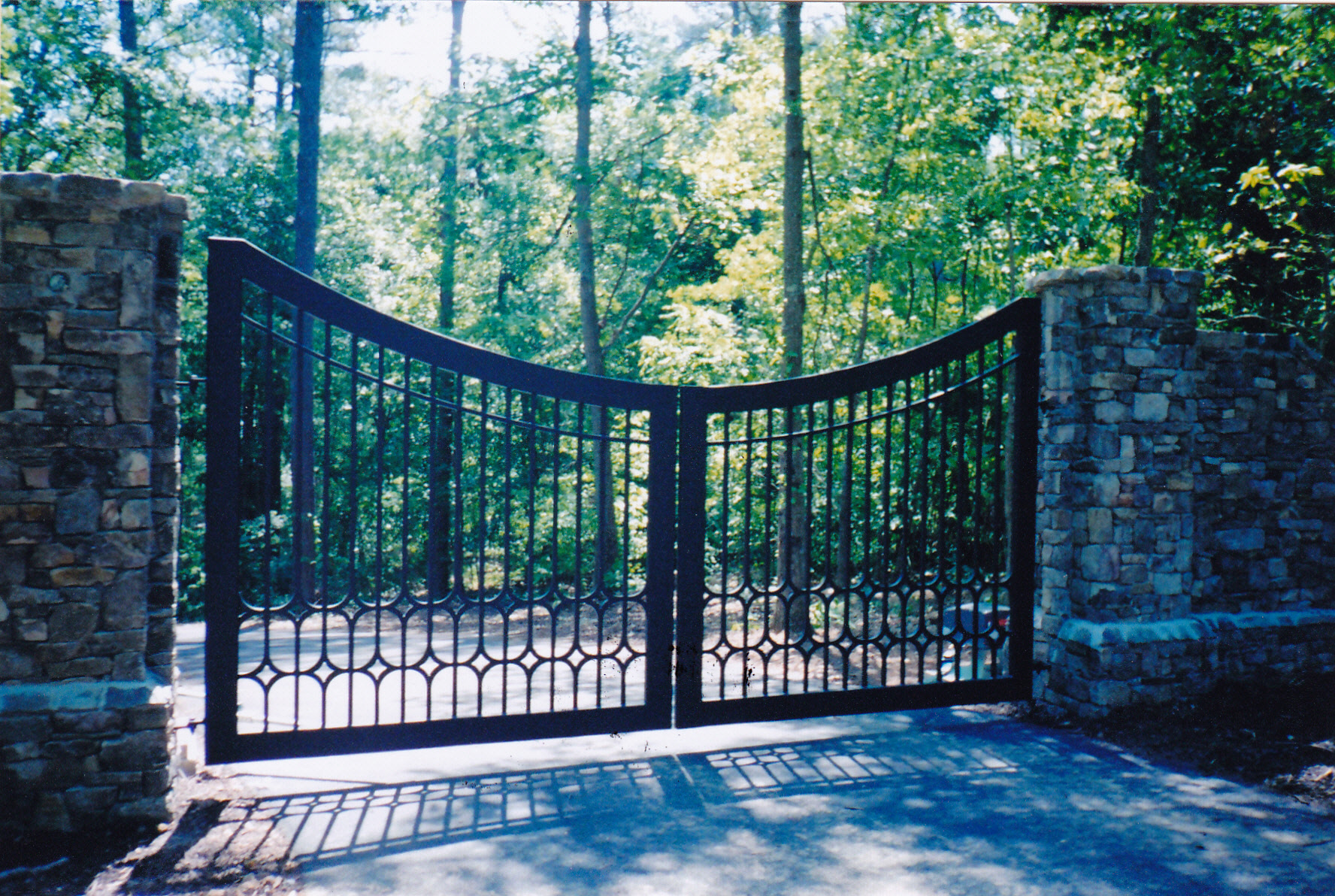
A single leaf is simple and economical on narrower openings, but a long single leaf puts a lot of weight on one post and one set of hinges. A double gate splits the opening into two shorter leaves that meet in the middle. Each leaf is lighter, sags less and needs less room to swing, and the bi-parting look is the classic estate entrance. Wide drives are usually better served by two leaves.
Material: steel, aluminum or wood and steel
Steel is the traditional “wrought iron” choice: rigid, strong and able to take almost any design.
Aluminum is lighter and won’t rust, which is easier on hinges and openers, but it’s less stiff on very wide spans.
Wood infill in a steel frame gives a warm, private look while the steel carries the load.
A solid panel gate gives full privacy. Solid leaves catch more wind, so posts, hinges and any opener need to be sized for it.
Style ideas
Flat top with straight pickets: clean and economical.
Arched or bell-curve top: the most popular estate look, often with finials and a scroll band.
Ranch style: horizontal rails for country properties and long drives.
Privacy panels: solid or semi-solid infill in steel or wood.
Modern geometric: diamonds, diagonals or grids.
Monograms and names: initials or a family or farm name worked into the gate or an arch above it.
Bring photos of gates you like to the consultation. Pictures of the house help too, since the best gates pick up details from the architecture.
Horizontal rails give an estate gate a clean, open look. Color is part of the design too.
Plan for automation, even if you don’t automate now
If there’s any chance you’ll want an opener later, tell us at the start. Post size, hinge type and placement, and the gate’s weight all affect which operator will work. Running empty conduit to the gate during installation costs little compared to trenching later. Our guide to automatic gate openers explains swing and slide operators, solar vs. hardwired power and safety devices.
Match the gate to the fence, columns and a walkway gate
A driveway gate rarely stands alone. Matching the picket style, finials and finish to your ornamental fence ties the entrance together, and a pedestrian gate beside the drive saves opening the big gate for every walk to the mailbox. See our walkway and garden gates for ideas. Brick or stone columns, lanterns and an address plaque finish the look.
A walkway gate with an iron frame and wood infill. A matching pedestrian gate saves opening the driveway gate for every trip on foot.
Frequently asked questions
How wide should a driveway gate be?
Wide enough for the vehicles that use it, at the angle they turn in, with room to spare. A drive off a narrow road needs more width than one approached straight on. We measure the opening and talk through your vehicles before recommending a size.
Should a gate open toward the road?
Usually not. A gate that swings out can block the road or sidewalk and is harder to use safely. Most gates swing in toward the property, and local rules may also apply.
Can you build a gate to fit columns I already have?
Yes. Every gate is measured and built for its own opening. We check the column spacing, how plumb the columns are and whether they can carry the gate’s weight.
Is steel or aluminum better for a driveway gate?
Steel suits heavy, traditional designs and wide spans. Aluminum is lighter and won’t rust, which helps with openers. The span, the look you want and whether you’ll automate usually decide it.


A driveway gate is one of the few things on a property you’ll use every single day, so it pays to choose it carefully. The right gate fits the drive, opens the right way for the slope, suits the house and can take an opener later if you want one. Here’s how to choose a driveway gate, taking the decisions in the order we’d make them: site first, then type, size, material and style.
We design and build custom driveway gates at our shop in Cave Spring, just southwest of Rome, and every gate is fitted to its own opening. If your main question is budget, start with our guide to what drives driveway gate cost. This post is about choosing the gate itself.
Start with the site
Before you look at styles, look at your drive:
Swing vs. slide gates
Swing gates are the most common choice for homes. Sliding gates solve specific site problems.
Is a sliding gate better on a hill?
Often, yes. A sliding gate moves parallel to the road, so the slope of the drive behind it matters much less. A swing gate can sometimes work on a slope with special hinges or by swinging toward the downhill side, but the site usually decides.
Single vs. double leaf
A single leaf is simple and economical on narrower openings, but a long single leaf puts a lot of weight on one post and one set of hinges. A double gate splits the opening into two shorter leaves that meet in the middle. Each leaf is lighter, sags less and needs less room to swing, and the bi-parting look is the classic estate entrance. Wide drives are usually better served by two leaves.
Material: steel, aluminum or wood and steel
Our wrought iron vs. aluminum vs. steel comparison goes into strength, rust and upkeep in more detail.
Style ideas
Bring photos of gates you like to the consultation. Pictures of the house help too, since the best gates pick up details from the architecture.
Plan for automation, even if you don’t automate now
If there’s any chance you’ll want an opener later, tell us at the start. Post size, hinge type and placement, and the gate’s weight all affect which operator will work. Running empty conduit to the gate during installation costs little compared to trenching later. Our guide to automatic gate openers explains swing and slide operators, solar vs. hardwired power and safety devices.
Match the gate to the fence, columns and a walkway gate
A driveway gate rarely stands alone. Matching the picket style, finials and finish to your ornamental fence ties the entrance together, and a pedestrian gate beside the drive saves opening the big gate for every walk to the mailbox. See our walkway and garden gates for ideas. Brick or stone columns, lanterns and an address plaque finish the look.
Frequently asked questions
How wide should a driveway gate be?
Wide enough for the vehicles that use it, at the angle they turn in, with room to spare. A drive off a narrow road needs more width than one approached straight on. We measure the opening and talk through your vehicles before recommending a size.
Should a gate open toward the road?
Usually not. A gate that swings out can block the road or sidewalk and is harder to use safely. Most gates swing in toward the property, and local rules may also apply.
Can you build a gate to fit columns I already have?
Yes. Every gate is measured and built for its own opening. We check the column spacing, how plumb the columns are and whether they can carry the gate’s weight.
Is steel or aluminum better for a driveway gate?
Steel suits heavy, traditional designs and wide spans. Aluminum is lighter and won’t rust, which helps with openers. The span, the look you want and whether you’ll automate usually decide it.
Start planning your driveway gate
Want help choosing the right gate for your drive? Call (706) 232-2642 or send us a message for a free quote, and browse our custom driveway and entrance gates for styles we build.
Fabco Fabrications, Inc., 5592 Cave Spring Rd SW, Cave Spring, GA 30124, just southwest of Rome. Open Monday through Friday, 9 a.m. to 5 p.m.